
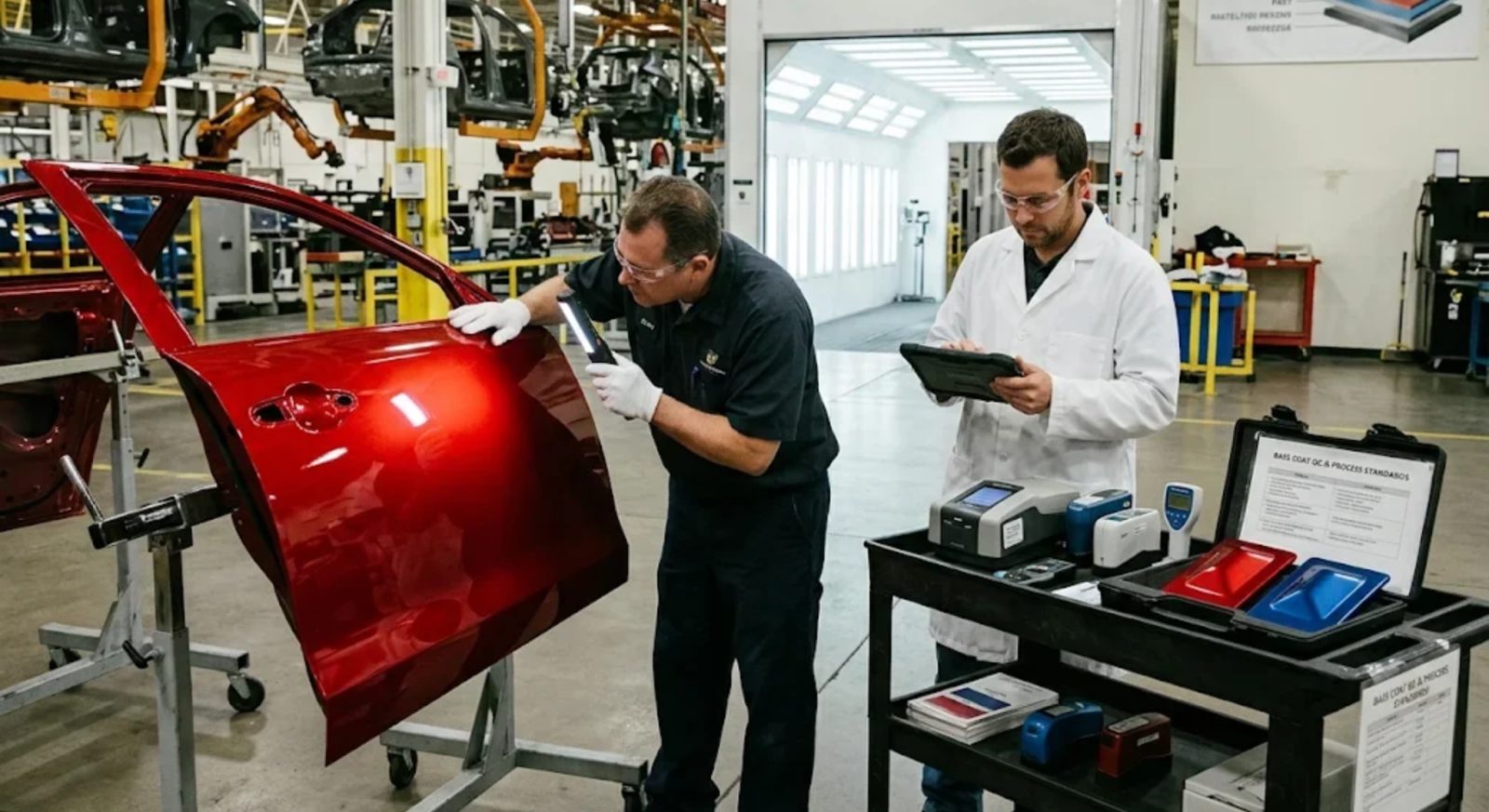
In modern manufacturing and industrial design, product quality is evaluated long before an end-user examines internal components or functional specs. It is judged instantly on surface presentation. Whether looking at consumer vehicles, commercial fleets, or high-end industrial equipment, exterior finishes communicate craftsmanship, structural integrity, and brand value.
Achieving a high-depth, durable finish requires a complex balance of chemical engineering, physics, and application precision. At the heart of this multi-stage finishing process lies the base coat the core layer responsible for color, opacity, and visual effects. Understanding how engineered Automotive Base Coat systems operate offers valuable insights into how material science and sustainable manufacturing intersect to deliver superior product quality.
Deconstructing the Multi-Layer Coating Stack
A professional automotive or industrial surface finish is rarely a single spray layer. Instead, it relies on a multi-stage system where each layer performs a distinct mechanical and visual function:
- Substrate Preparation & E-Coat: The foundational metal or composite pretreatment that shields against corrosion and ensures structural adhesion.
- Primer Surfacer: Fills microscopic imperfections, levels the surface, and provides a uniform background tone while acting as a barrier against chip damage.
- Base Coat: The visual engine of the system. It carries the primary pigments, light-absorbing compounds, micro-flake effect particles, and binder resins that establish exact color match and depth.
- Clear Coat: The protective top barrier that provides high gloss, UV protection, chemical resistance, and defense against physical abrasion.
While the clear coat supplies physical defense, the base coat defines the aesthetic identity. Without a stable, high-density base layer, even the most durable topcoat will fail to deliver visual depth or uniform coverage.
The Chemical Evolution: Solventborne vs. Waterborne Systems
For decades, industrial coatings relied heavily on organic solvent carriers to suspend resins and pigments. Solventborne paints offered rapid evaporation and straightforward application, but they released significant volumes of Volatile Organic Compounds (VOCs) into the atmosphere.
As corporate sustainability standards and environmental regulations have tightened globally, manufacturers and collision centers have transitioned toward advanced waterborne formulations.
| Operational Feature | Traditional Solventborne Base Coats | Modern Waterborne Base Coats |
| Primary Carrier Medium | Volatile Organic Solvents | Water (~70–80%) + Cosolvents |
| Environmental Footprint | High VOC emissions | Dramatically reduced VOC profile |
| Pigment Hiding Power | Moderate pigment dispersion | Exceptional pigment density and stability |
| Drying Dynamics | Ambient solvent evaporation | Requires controlled temperature & airflow |
Modern waterborne coatings utilize advanced acrylic-polyurethane latex dispersions and micro-gel matrices. This high pigment density allows operators to achieve total coverage in fewer spray passes, reducing overall material consumption and reducing shop emissions without compromising color accuracy.
Particle Orientation and Optical Physics
Achieving modern metallic, pearlescent, or color-shifting finishes is a masterclass in optical physics. The visual impact of these finishes depends entirely on how light interacts with micro-particles suspended within the wet base coat layer.
- Metallic Flakes: Microscopic aluminum platelets act as thousands of tiny mirrors. During application, these flakes must align parallel to the substrate. Proper alignment creates a bright, reflective “face” view when viewed head-on and a smooth, darker “flop” tone when viewed at an angle.
- Pearlescent Pigments: Synthetic or natural mica flakes coated with ultra-thin metal oxides (such as titanium dioxide) induce light interference. Light bounces off both the outer oxide shell and the inner mica core, refracting into distinct color shifts based on the oxide layer’s thickness.
If viscosity, atomization pressure, or flash-off timing are improperly managed, these effect particles settle unevenly, causing defects such as mottling, striping, or unwanted shade variations.
Thermal Performance and Modern Material Efficiency
Beyond aesthetics, modern base coat engineering plays an increasingly functional role in energy management. In electric vehicles and climate-conscious fleets, exterior surface temperatures directly impact HVAC power draw and overall energy efficiency.
Advanced pigment design has introduced solar-reflective base coat technologies. By incorporating pigments engineered to reflect near-infrared (NIR) solar radiation while maintaining visible color absorption, these coatings keep surface temperatures cooler in direct sunlight. This functional approach demonstrates how surface coatings contribute to broader operational efficiency goals.
Conclusion
Surface finishing is far more than a decorative final step in production; it is an engineered discipline that balances aesthetics, protection, and environmental responsibility. Modern Automotive Base Coat technologies highlight how pigment science, waterborne chemistry, and optical engineering combine to create durable, beautiful, and sustainable finishes. As material science continues to evolve, high-performance coating systems will remain central to delivering exceptional build quality across industrial and automotive sectors.
Frequently Asked Questions (FAQs)
What is the primary role of an automotive base coat?
The base coat provides the finish with its specific color, opacity, and special visual effects (such as metallic flake shimmer or pearlescent shifts). It relies on a clear coat applied over it to achieve high gloss and protection against UV radiation and physical wear.
Can a base coat be applied directly to bare metal?
No. Base coats are formulated specifically for color density and flake suspension, not direct substrate adhesion or rust prevention. Bare metal must first be treated with an etch or epoxy primer, followed by a primer surfacer, before applying the base coat.
Why is flash-off time important during base coat application?
Flash-off time allows the liquid carrier (water or solvent) to evaporate partially from an applied layer before adding the next pass or applying the clear coat. Skipping flash time can trap liquids under subsequent layers, causing defects like solvent popping, hazing, or uneven flake orientation.
How do waterborne base coats dry compared to solventborne paints?
Waterborne paints rely heavily on controlled relative humidity, ambient temperature, and forced airflow to evaporate their water content. Commercial spray booths typically utilize high-velocity air blowers (venturi systems) to accelerate flash times between coats.

